Perspective: Without Jesse Jackson, There Is No Barack Obama
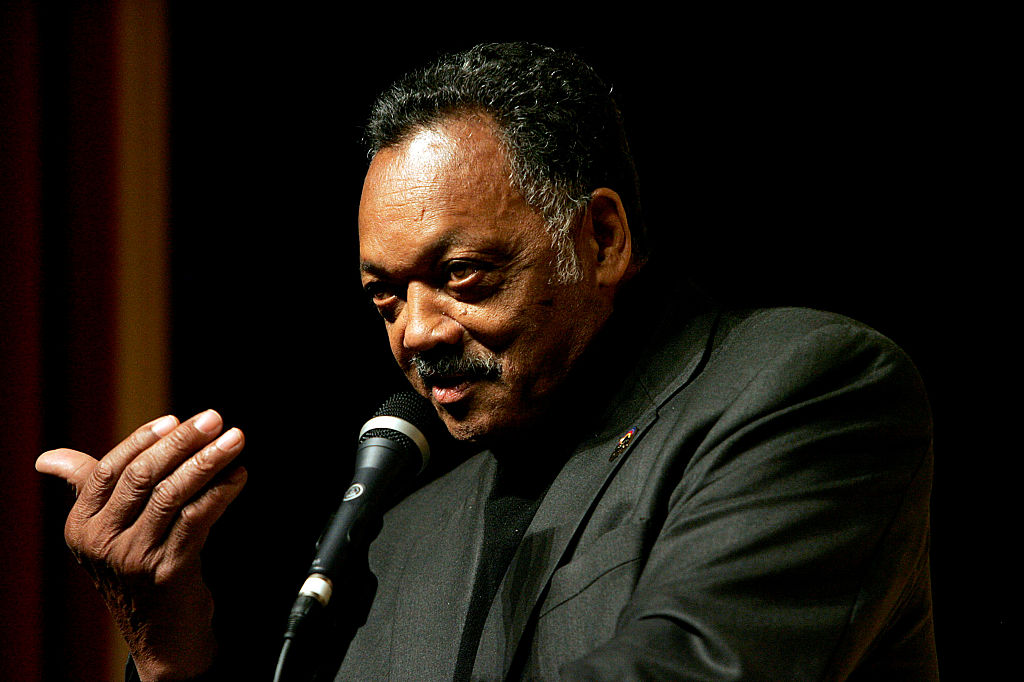
Reverend Jesse Jackson has died. He was the architect of modern multiracial progressive politics, the man who stretched the boundaries of who America could see as presidential, and one of the last living bridges between the Civil Rights Movement and the political world we are still fighting to build.
The tributes have been rolling in all day.
Cable news has been looping archival footage. Old campaign stops. Convention speeches. Marches. Sermons. And the cadence of a voice that, for decades, sounded like both warning and promise.


And over and over, they keep replaying that clip of Jackson on Election Night 2008. We see him with tears streaming down his face as Barack Obama is declared the next president of the United States. The camera lingers on him, jaw tight, eyes wet. His was an expression that looked like relief and grief sharing the same body.
And all day, pundits have been asking the easy question: What did Jesse Jackson mean to America?
But here’s the harder truth that today demands we say out loud: Without Jesse Jackson, there is no Barack Obama presidency.
Jackson did not just run for president in 1984 and 1988. He rewired the political imagination of this country. He forced America, and more importantly, the Democratic Party, to confront the possibility that a Black candidate could stand on a national stage and speak not just for Black people, but for the moral direction of the nation itself.
Before Jackson, Black presidential runs were largely treated as symbolic gestures of presence. Necessary, yes. But not structurally threatening to the two-party power system. But Jackson shattered that containment.
Jackson’s 1984 run did three things that are structurally necessary for Obama to even be not just electable, but thinkable.
First, Jackson normalized the sight and sound of a Black candidate running a national campaign that was not confined to “Black issues.” Before Jackson, the dominant political imagination cast Black candidates as local, urban, or protest-oriented. Jackson walked into the 1984 Democratic National Convention and said his constituency is the desperate, the damned, the disinherited, the disrespected, the despised, and the poor across race, across region, across class.
That is exactly the rhetorical architecture Obama later uses when he shifts from “Black candidate” to “national unity candidate.” The quilt becomes “there is not a Black America and a white America.”
Second, Jackson built the multiracial progressive coalition math that Obama later inherited. Long before Obama campaign strategists were building turnout models around multiracial urban coalitions, young voters, progressive white suburbs, and working-class crossover voters, Jackson was building the moral and rhetorical framework for that exact coalition. So, you can see how the Rainbow Coalition was a political blueprint.
When Jackson spoke about the Rainbow making room for Arabs, Latinos, farmers, labor, queer folks, Native people, farm workers, and youth, he was articulating a theory of political survival rooted in shared vulnerability and shared economic struggle. And, he was literally beta-testing the coalition model that became the Obama electoral map. Obama did not invent coalition politics. It emerged from decades of organizing and messaging that Jackson helped legitimize inside the Democratic Party, even when party leadership resisted him.
Third, and this is the part that’s often missed, Jackson changed white voters’ psychological tolerance. By 2008, millions of white voters had already spent years watching a Black man stand on the biggest political stages in America speaking moral authority, economic policy, foreign policy, nuclear policy, labor rights, farm crisis, Middle East diplomacy, and coalition theory. That matters because political viability is not merely a matter of policy; it is the emotional conditioning of the electorate.
Jackson didn’t just move Black voters. He moved the boundaries of white political imagination. He made it possible, not inevitable, but possible, for white voters to see a Black man as a potential vessel for national leadership without automatically coding that leadership as “racial special interest.”
And then there is symbolism and emotional infrastructure. The part you can’t quantify in exit polls. Jackson’s language about the quilt, the rainbow, and shared destiny was doing nation-building work long before Obama’s “not a Black America and a white America” speech. Obama translated that moral vision into a post-Cold War, post-9/11 political vocabulary. But the emotional groundwork had already been laid.
So when we see Jackson crying in 2008, we are not just watching a proud elder witness history. We are watching a man who spent decades expanding the possibilities watch another Black man walk through a door he helped pry open with his bare hands.
That’s why those tears hit so hard.
Because every movement elder knows that feeling. The mixture of pride and exhaustion. Of victory and memory. Of knowing how many doors slammed in your face so somebody else could walk through one that opened. And when you read Jackson’s 1984 DNC speech through that lens, you see it everywhere.
When he says leadership must be tough enough to fight and tender enough to cry, that is emotional permission for a different kind of masculinity in politics. Obama later runs as the calm, thoughtful, reflective leader instead of the chest-thumping Cold War warrior.
When he says democracy guarantees opportunity, not success, that is the philosophical bridge between civil rights era moral language and late-20th-century economic and political language. Obama lives on that bridge.
When Jackson says that if Black folks vote in great numbers, progressive whites win, Hispanics win, women win, children win, workers win, that is literally the coalition math of 2008 turnout strategy. Even the youth section matters. Jackson directly calls young voters into political agency. By the time Obama runs, young voters are already primed to see presidential politics as something they belong in, not something old white men do on television.
Now, where we have to be careful is not to flatten history into “Jackson caused Obama.” Because historically it’s more accurate, and honestly more powerful, to argue that Jackson expanded the possible. He widened the corridor that Obama later walked through.
Without Jackson, you likely still get Black candidates. But you do not get a Black candidate who can plausibly be framed as the vessel of national unity in a majority-white electorate in 2008. That is a different thing.
There’s also the party infrastructure piece. Jackson forced the Democratic Party to engage Black voters not just as a loyal base but as a strategic negotiating bloc. That shift directly affects how the party later invests in Obama’s viability.
And then there’s symbolism. The Rainbow Coalition language was emotional nation-building work. Obama’s entire 2008 campaign was emotional nation-building work. He just translated it into post-Cold War, post-9/11, post-Iraq language. Jackson made it possible for a Black candidate to speak in the register of national destiny rather than in the register of racial exception. Obama made it possible for white America to vote for that voice without feeling like they were voting outside of American identity.
And now, as America reflects on Jackson’s life, we have to resist the urge to flatten him into safe nostalgia.
Jesse Jackson was inconvenient. He was loud when the political establishment wanted quiet. He forced conversations about poverty when both parties wanted to talk only about middle-class comfort. He pushed the Democratic Party to confront its dependency on Black voters while simultaneously marginalizing Black leadership.
He lost two presidential races. But he changed the terrain on which those races were fought. And history is full of people who lost elections but won the future. Jackson belongs in that category.
Today, as the tributes pour in and the footage rolls and the pundits speak in past tense, we need to be honest about what kind of figure Rev. Jesse Jackson actually was. Not just a civil rights leader. Not just a preacher. Not just a candidate. He was an architect of political possibility.
Obama did not come out of nowhere. He came out of decades of movement pressure, coalition building, rhetorical expansion, and psychological normalization. He came out of a country that had already been forced, kicking and screaming, to imagine Black national leadership as something more than symbolic protest. Jackson helped force that imagination into existence.
And if you want to understand the full weight of that 2008 moment, if you want to understand why Jackson cried and why he looked like a man holding both history and relief in his chest at the same time, then you have to understand that sometimes the most important leaders are not the ones who get to sit in the chair.
Sometimes they are the ones who make it possible for someone else to sit there at all. And Jesse Jackson did that for America.
Dr. Stacey Patton is an award-winning journalist and author of “Spare The Kids: Why Whupping Children Won’t Save Black America” and the forthcoming “Strung Up: The Lynching of Black Children In Jim Crow America.” Read her Substack here.
SEE ALSO:
Civil Rights Leader Jesse Jackson Dies At 84
Jesse Jackson’s Campaigns Offer Blueprint For Defeating American Extremism
Perspective: Without Jesse Jackson, There Is No Barack Obama was originally published on newsone.com